 Paris, France ·
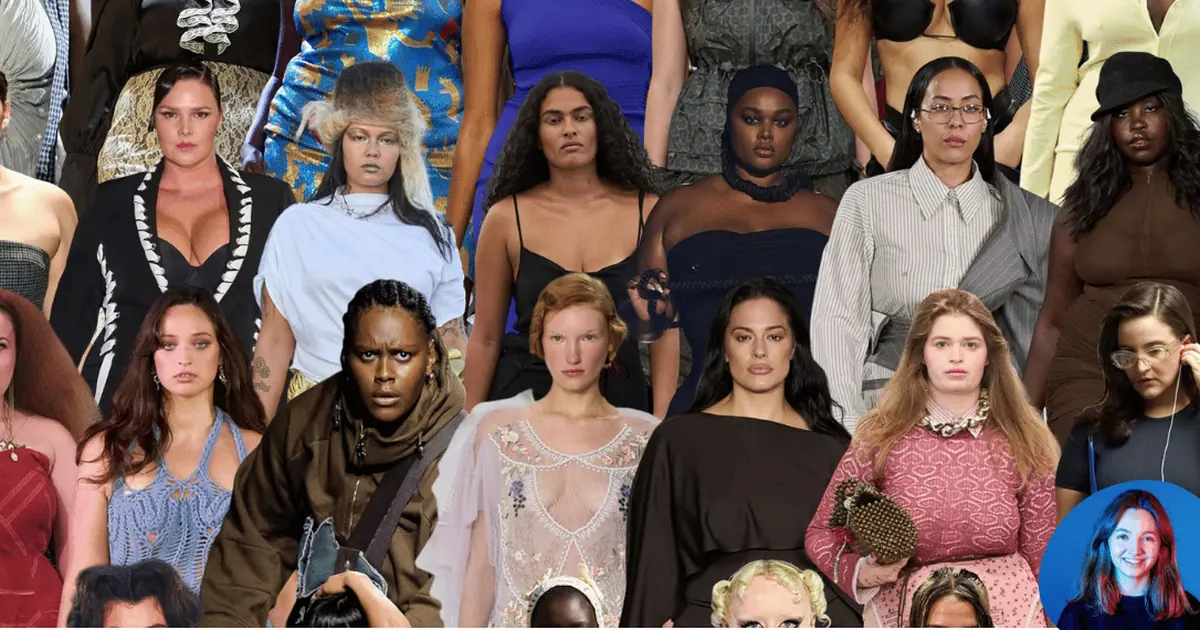
Fashion seemed to have opened the door to a new era of body diversity. Yet within a few seasons, runways have gone back to a single silhouette: white, thin, silent. This regression is not merely aesthetic. Algorithms, the “clean girl” and “trad wife” aesthetics, the glorification of a return to thinness and the rise of masculinism are building a new image of the feminine: more disciplined, more docile, more controlled. This cultural hardening is part of a global context in which the far right, from Trumpism to European nationalisms, is reasserting its vision of a tighter social order. In this ideological realignment, women’s bodies are once again becoming central markers of discipline and conformity.
The Symptomatic End of Body Diversity on the Runway
One might have thought the fashion industry had turned for good toward greater inclusivity. Campaigns featuring models of color, older models and plus-size models had offered a glimpse of real change. Yet within a few seasons, diversity has evaporated. Runway silhouettes are falling into line, slimming down, becoming uniform. “The body positivity they were selling us in the 2020s [is] over, just one trend among others,” protests journalist Matthieu Bobard Deliere.
Clothing, long seen as a space for personal expression, now seems to be turning back into a tool of neutralization. As Manon Renault, a fashion researcher and fashion editor at Les Inrocks, puts it: “we no longer use clothing as a means of expression but of discretion.” Even brands that built their reputation on an unapologetic hyperfemininity are sliding toward a polished minimalism. Away from the runways, the e-commerce site Pretty Little Thing, once a symbol of a rather showy aesthetic, has now adopted the codes of “quiet luxury.” “They said: fuck BBLs, fuck fat girls, here we’re skinny and clean girls. Here we’re chic and racist,” quips content creator Monsterlool.
The same shift can be seen among reality TV stars: those who once embodied the BBL aesthetic are having their implants removed, losing weight and adopting a more “demure” style. Taken together, this tells the story of a return to a single body type, presented as more chic, more “healthy,” more presentable.
Algorithms, Trends and Social Media: The Daily Manufacture of the Docile Body
What happens on the runway never stays confined to fashion for long. These standardized silhouettes are quickly picked up, amplified and normalized by algorithms, which turn an aesthetic trend into a cultural norm. Algorithms optimize what performs: smooth, bright, discreet, repeatable. The “clean girl” promises visual purity (bare skin, brushed-up brows, slicked-back hair, neutral tones); the “trad wife” sells an orderly, domestic, “natural” femininity. These formats lend themselves to recommendation loops: you click, you watch, you get served more of the same.
Meanwhile, masculinism is gaining media visibility. Content cheering “the end of body positivity” circulates widely, often dressed up in the language of health (“discipline,” “optimization,” “clean eating”). These rhetorics, though neither uniform nor always coordinated, converge: they re-legitimize thinness as a moral and aesthetic ideal. The symbolic gains of recent years in diverse representation (plus-size, trans, older bodies) are once again treated as deviations to be corrected. Social media, once a driver of visibility for marginalized bodies, has ended up accelerating a narrower imaginary.
The Politics of the Body
Bodily uniformity never happens in a vacuum. It takes on a particular meaning at a time marked by the rise of the far right across Europe and around the world. The work of George L. Mosse, Zeev Sternhell, Emilio Gentile and Enzo Traverso reminds us that authoritarian ideologies act first on representations: on bodies, health, sexuality, gender roles. Fascism, they write, is not merely a political apparatus. It is a culture that seeks to “transform the collective imagination and change ways of life”:
Fascism was at once a revolution, an ideology, a worldview and a culture. A revolution, because it did not look to the past but sought to build a new society. An ideology, because it conceived of nationalism as a modern alternative to both socialism and liberalism. A worldview, since it placed its political project within a philosophy of history. And a culture, since it sought to transform the collective imagination, change ways of life and erase any divide between private and public life. (Traverso, 2008)
Recent events give this reading a particular resonance: the return of Trumpism to the American political stage, electoral breakthroughs by the far right in Europe, repeated attacks on reproductive rights and on minorities. In these contexts, the female body is once again a central issue: a discreet, controlled, standardized body fits a social order in which the margins shrink, whereas a visible, diverse, assertive body becomes a form of dissent.
It is precisely within this tension that part of today’s cultural debate is playing out.
A “Messy,” “Brat” and Noisy Resistance
Rebellion exists, and it matters. Artists are defying homogeneity: Théodora and others show off provocative, “messy” looks that scramble the codes; the “messy girl era,” the Brat summer of Charli XCX and the aesthetic of Ke$ha bring back noise and friction. These gestures are not superficial: they are aesthetic refusals of order, invitations to take back visual space. These currents reject smoothness: they remind us that imperfection, excess or eccentricity can be legitimate forms of representation and self-expression. Resistance also means training your eye: refusing monotonous feeds, diversifying your sources, supporting media that make room for other bodies, questioning “health” imperatives when they serve exclusionary aesthetics.
Reasserting the Power of the Body as a Site of Struggle
The narrowing of acceptable bodies is not just a matter of aesthetics; it is an indicator of the state of a society. Which raises a question: how can we resist and reopen the imaginary?
- Change the way content is recommended by helping those around you, and users in general, to spot and get around normalization loops.
- Demand clear, public and lasting commitments on body diversity, to move beyond opportunistic, short-lived campaigns.
- Support alternative scenes that showcase “messy” creators, communities and aesthetics, to bring back visual pluralism.
- Keep the political stakes in mind, remembering that aesthetics are never neutral: controlling bodies is a way of controlling society.
Protecting this plurality is not “political correctness”: it is a way of keeping open a space where everyone can exist outside narrow imperatives.
To Sharpen Your Eye
Plus personne ne s’indigne du manque d’inclusivité dans la mode
Comment l’évolution des standards de beauté reflète la montée du fascisme | URBANIA FR
Observatoire de l’imaginaire contemporain
The Vogue Business Spring/Summer 2026 size inclusivity report | Vogue