 United Kingdom · ·

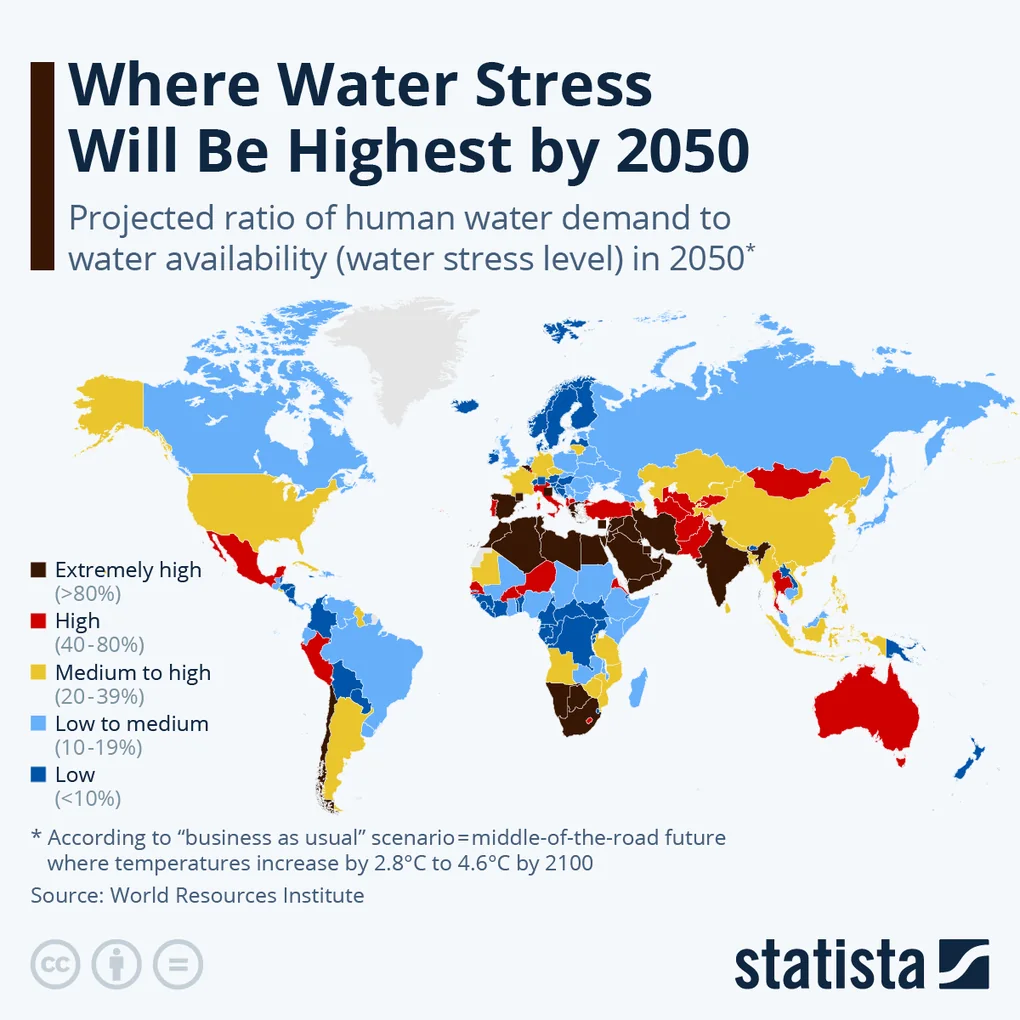
More often than not, people acknowledge water scarcity as a result of insufficient supplies of fresh water and inadequate infrastructure to contain it. And when they consider the growing impact of climate change, which in turn causes disruptions to the water cycle, making infrastructure harder to remain effective, it’s a fairly reasonable assumption, right? But there is not much attention being brought to a crueller culprit. The root cause of water scarcity is caused by depletion. Not of simply water, but of effective governance. With the ongoing water crisis, there is ongoing water privatisation, pollution and negligence. The reducing availability of water struggles to sustain the demand of ulterior motivated companies. The global water crisis has a devastating impact (Figure 1), affecting four billion people per year. The effect is further compounded in poorer regions. In Sub-Saharan Africa, for example, three in five children lack sufficient water. We can see that SDG 6 (Clean Water and Sanitation), in turn impacts SDG 4 (Quality Education) which consequently effects SDG 8 (Decent Work and Economic Growth).
Ambiguous Accountability
Rather than focussing on improving infrastructure, improving accountability to Governance and financing is the key to solving water scarcity. Promoting systematic change, which falls under SDG 16 (Peace, Justice and Strong Institution) in turn advances multiple interconnected goals, including water access, education and employment. As expected, changing the ways we systematically solve the water crisis will be met with resistance. Major policy changes are often blocked when the people who support the original policy remain in power. The way many Governments are set up, can act as a barrier to citizens who want to make change. From this, accountability is hampered. There is also a systematic weakness in policy that worsens this situation: ambiguity in institutional responsibilities, and the absence of clear sanctions and clear standards, make it harder to hold someone, or some organisation, responsible for their actions.
Gathering Grassroots Power
Grassroot organisations, which are community based, citizen lead initiatives, are a powerful voice against this lack of accountability. These organisations demand answerability from those worsening the water crisis. They do so by strategically using crisis events, and overwhelming media coverage, to pressure governments into changing their policies to put citizens interests first. In the early summer of 2015 in G City, China, the Si Ma Chong river went from natural blue to a scarlet red. This case was referred to as The Red River Incident, where a company, in attempt to dispose of sewage illegally, polluted a river in a way that couldn’t go unnoticed. During the site inspection that followed this, the environmental bureau official gave only a brief assessment, dismissing the river’s condition as nothing more than muddy water. This is where grassroots played a pivotal role. The Le Xing Si Ma Chong Water Conservation Team leveraged overwhelming media coverage to ensure accountability. The widespread media from the river’s colour caused the grassroots group to expand its capacity by integrating social expertise and water quality testing technology. This involved The Association of Old Engineers, a group of senior retired engineers, who provided guidance to deepen the activist’s knowledge of China’s river systems. Targeting key concepts such as the source, flow area, and structure of the Si Ma Chong river body. By integrating expertise, activists were equipped for effective change and gathering sufficient evidence, transitioning their efforts from basic complaints to sustained, impactful action. This case was considered a “fuse” that drove grassroots organisations to adopt a more radical advocacy model. Overall, the group’s voices and media pressured government led water treatment coalitions to make behavioural amendments and policy concessions.
Investing in Intellect
The best way to invest in the water crisis is to invest in knowledge. By linking grassroot groups with professional resources, we enhance their ability to provoke change. The guidance of retired senior engineers, as highlighted in the Red River Incident, was a fundamental way of knowing the right questions to ask and the key points to mention regarding policy implementation. Additionally, young leaders are proposing innovative, locally rooted solutions such as open-data platforms and nature-based interventions, steering discussions beyond physical infrastructure to governance reform. Policy brokers facilitate learning by dissolving misconceptions, reframing issues, and enabling knowledge co-production between stakeholders. While powerful, grassroots efforts face significant challenges. Policy analysis tools traditionally ignore crucial social factors outside the policy subsystem. Academic research can use inaccessible language and operate on different timescales than decision-makers, inhibiting the translation of evidence into usable policy. Grassroots efforts can also fail due to divergence in beliefs, lack of necessary resources, and low levels of trust and legitimacy between government and civil society.
The Future Forward
In the midst of the water crisis, a community voice is needed, and it can be achieved by a foundation of strong knowledge and media exposure. Establishing effective political, community dialogue creates an inter-embedded model of governance. By strengthening governance through SDG 16, empowering communities through SDG 17 (Partnerships for the Goals), and ensuring transparent accountability, we can secure clean water for all under SDG 6, and unlock progress across education, health, and economic development. The question is not whether we have enough water, it’s whether we have the political will to govern it justly.
Sources
Author’s references
Journal Article
- Zeng, D., Yin, Y., Yan, H. and Guo, P. (2023). Crisis-Assisted Policy Advocacy in Water Environment Governance: The Policy Game Mechanism of Grassroots Organizations. Water, 15(13), p. 2459. DOI: 10.3390/w15132459. Accessed 24 November 2025.
Reports & Working Papers
- Hepworth, N.D., Brown, B.D. and Brewer, T. (2020). Accountability and advocacy interventions in the water sector: a review of global evidence. Part 1. Overview and Summary Results. Edinburgh, UK: Water Witness International. Available at: Accountability and advocacy interventions in the water sector: a global evidence review | H2Open Journal | IWA Publishing. Accessed 24 November 2025.
- Gardner, V. and Brassington, L. (2022). Why open access is not enough: Spreading the benefits of research (HEPI Policy Note 42). Oxford: Higher Education Policy Institute (HEPI) and Taylor & Francis. Available at: Why open access is not enough: Spreading the benefits of research – HEPI. Accessed 24 November 2025.
- Blackmore, C., Ison, R. and Collins, K. (no date). Supporting Water Governance and Climate Change Adaptation Through Systemic Praxis. Available at: Communication for the Commons: Revisiting Participation and Environment. Accessed 25 November 2025.
- Global Commission on the Economics of Water (2024). Youth Water Agenda: Transforming the Future of Water Security. Available at: Youth Water Agenda: Transforming the Future of Water Security – Global Commission on the Economics of Water. Accessed 25 November 2025.
Online/Organizational Documents
- SIWI (Stockholm International Water Institute) (2025). Youth and water. Available at: Youth and water | SIWI – Leading expert in water governance. Accessed 25 November 2025.
- Corradi, S. (2025). Voice from the youth: “Empowering water change-makers: Youth Advocacy Training” | World Water Council. Available at: Voice from the youth: “Empowering water change-makers: Youth Advocacy Training” | World Water Council. Accessed 25 November 2025